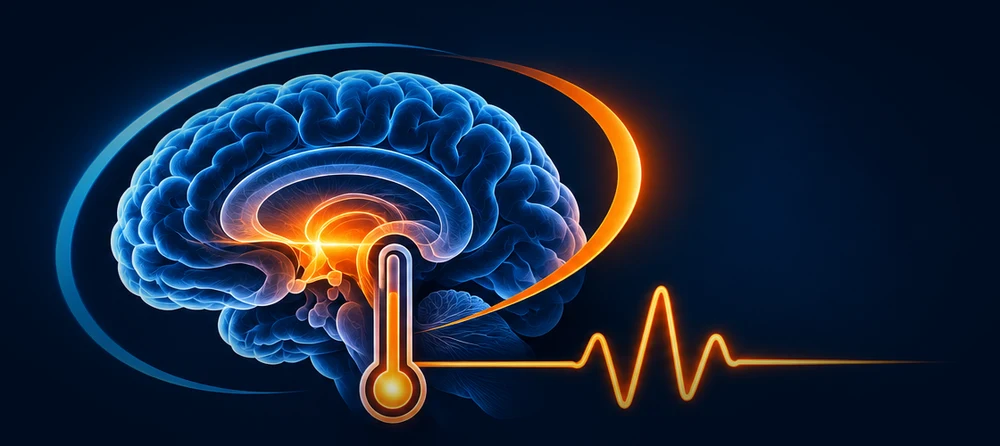
Beyond temperature. Into clinical reasoning.
THERMIND: Fever is a clinical signal, not a diagnosis.
A learning and reasoning platform for fever after acute brain injury. It maps the thermoregulatory pathways, walks you through infectious and non-infectious explanations, shows the evidence behind each step — and where that evidence runs out.
The principle
A fever says something is happening. It does not say what.
Infection, inflammation, injury, drugs and autonomic storms all raise the temperature. THERMIND will not answer “central fever” or “infection” for you. It shows which explanations remain open, what has not been excluded yet, and how strong the evidence is at each step — so the thinking stays yours.
Common, and often not infectious
In one neuro-ICU cohort central fever accounted for 46.8% of fevers; in another, a third of febrile patients had no documented infection. Evidence-supported
Central fever is a diagnosis of exclusion
There is no test that confirms it. A single negative culture, a flat curve or an early onset is never enough on its own. Expert interpretation
Both can coexist
A patient with SAH can have central fever and ventriculitis. Infection management runs in parallel and is never delayed by the search for a central cause. Expert interpretation
- Neurological contextInjury, devices, trajectory
- Fever phenotypeTmax, site, timing, pattern
- Infection evaluationWhat is done, pending, missing
- AlternativesDrugs, VTE, transfusion, PSH
- SynthesisRanked, with uncertainty shown
- OutputA note you can document
Neuroanatomy · thermoregulatory pathways
The geography of central fever is a network, not a centre
Thermoregulation is distributed. The preoptic area is a major integration hub, but sensing, autonomic output and behavioural responses run through connected brainstem, spinal and peripheral pathways. Anatomy informs plausibility; bedside evaluation and exclusion of dangerous alternatives determine action.
Sensory inputIntegration and outputContextual / uncertainInjury territory
Show
Overlay
Text description of the network
Simplified route: skin and visceral thermoreceptors → spinal dorsal horn → lateral parabrachial nucleus → preoptic hypothalamus. Descending control: preoptic area → dorsomedial hypothalamus → rostral medullary raphe → spinal sympathetic and somatic outputs. A teaching abstraction; circuits differ by species and effector.
Clinical Reasoning
Six stages. Missing is never negative.
Every field starts as not assessed. The synthesis treats unknown, pending and negative as different states and shows its reasoning. Nothing you enter leaves this device; a draft is kept only in this browser.
Fever phenotype
Persistent: > 6 h on ≥ 2 consecutive days
Response to antipyretics or cooling
Infection evaluation
Recommended items depend on the devices and context entered above.
Non-infectious alternatives
Output
Review and edit before it enters any record. The tool does not prescribe, stop antimicrobials or set temperature targets.
Evidence
Every prompt traces to a source — and states its limits
Evidence labels
If central fever is the working diagnosis
Management is largely extrapolated: cooling and antipyretics are used, and agents such as bromocriptine are used off-label on limited data — one retrospective cohort of 33 patients found temperature falls of 0.3 °C at 24 h, 0.5 °C at 48 h and 0.7 °C at 72 h. Emerging evidence
Temperature targets belong to your local protocol and current guidelines; this tool does not set them.
Clinical Cases
Practise the reasoning before you need it
Fictional teaching cases, not real patients. Read the case, commit to your own answer, then open the reasoning — or load the case into Clinical Reasoning and work it through stage by stage.
About and governance
What THERMIND is — and is not
It is
- A structured reasoning and learning environment.
- A framework for comparing competing explanations.
- Evidence-linked, and open about uncertainty and missing data.
It is not
- A calculator that returns “central fever” or “infection”.
- An autonomous diagnostic authority.
- A shortcut that equates negative cultures with central fever.
- A replacement for bedside assessment, cultures, imaging or local protocols.
- A validated score.
Authorship
Created and clinically edited by Dr Mohamed Najm Aldeen Alameen, neurologist in neurocritical care and neurological emergencies (ORCID 0009-0001-5506-2757).
Version · rules reviewed . Intended users: clinicians and trainees in neurocritical care. Privacy: no accounts, no data transmitted; anonymous page counts only. AI tools assisted search, drafting and code; selection and judgement are the editor's. Corrections: [email protected].
Clinical validation pathway
| Phase | Activity | Status |
|---|---|---|
| 1. Content verification | Independent clinical review of definitions, red flags, references and wording. | Seeking reviewers |
| 2. Usability testing | Neuro-ICU clinicians using synthetic cases. | Planned |
| 3. Retrospective evaluation | Compare outputs with independent expert review on a defined cohort. | Planned |
| 4. Prospective evaluation | Workflow impact, safety and trust under governance approval. | Planned |
| 5. Ongoing governance | Evidence updates, feedback, change control. | Change log below |
Change log. 1.0.0 (7 Nov 2026): first public version as NEUROTHERM. 1.1.0 (7 Nov 2026): renamed THERMIND; four pillars (Neuroanatomy, Clinical Reasoning, Evidence, Clinical Cases); five teaching cases; an explicit “where the evidence runs out” panel in the synthesis.